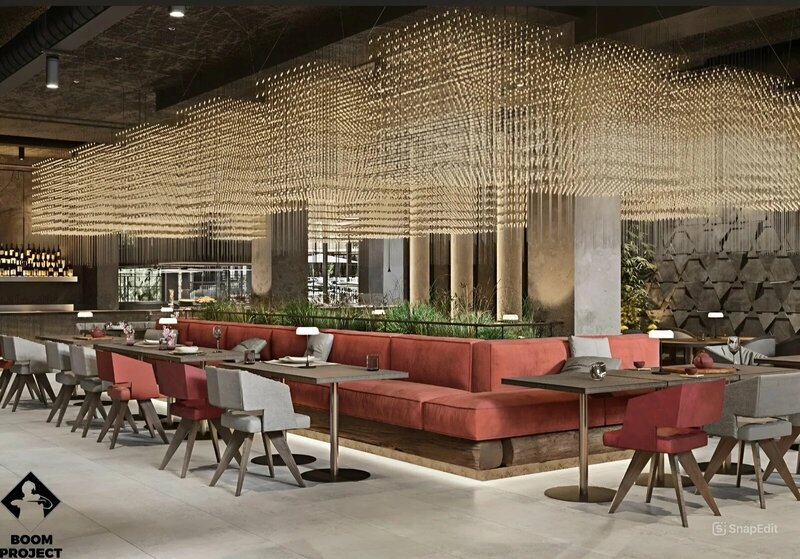
Should Wes Anderson ever turn his attention to a dinner set in a European grand hotel, it might look rather like this. Château Fantôme draws on the faded grandeur of historic hotels and the composed, cinematic symmetry of Anderson’s films: dark wood, claret velvet, brass, marble, and keyhole mirrors rendered in an Art Deco–neoclassical vocabulary.
The evening’s real drama begins at the table. Dinner comes with an immersive performance: artists appear among the guests, scenes play out across the room, and the narrative carries on through the evening. The kitchen moves between Europe and Asia, with duck ravioli in truffle sauce, duck confit with ptitim and chanterelles, sashimi, sushi and rolls. Prices are in keeping with the surroundings: chicken Caesar, KZT 8,900; chicken-liver and foie gras pâté, KZT 4,500; and crab phalanx in béchamel, KZT 44,900. The main restaurant is joined by a sizeable ballroom and a separate karaoke room.
De Zhuang sets out two distinct approaches to Chinese dining across its two floors. Downstairs, the focus is hot pot: a meal assembled at the table from a chosen broth, meats, seafood, vegetables and other additions, then cooked as it goes. Tomato and Sichuan-pepper broths are both KZT 5,000. Marbled beef is KZT 3,500, lamb KZT 3,000; mushrooms, greens and further accompaniments complete the spread.
Upstairs, the mood shifts to an à la carte restaurant. Cheese spring rolls (KZT 7,800), Sichuan-style beef (KZT 4,880) and beef dim sum (KZT 4,000) form the heart of the menu, with miniature sweet potatoes and osmanthus for dessert (KZT 2,000).
Almaty’s newest arrival has a decidedly glamorous point of reference: Studio 54, the legendary New York club where film stars, musicians and society regulars converged in the 1970s. Kultura 54 takes both its name and its fascination with nightlife from that era. The evening is designed to begin with dinner, then move on to cocktails and dancing.
European cooking provides the framework, with Asian notes woven through it. The opening choices range from hummus with paratha and chimichurri (KZT 4,500) to chicken-liver pâté with berry coulis (KZT 5,900) and fried prawns with wasabi sauce (KZT 7,500). Later, there is pasta with slow-cooked cheeks (KZT 8,100), a French-style burger with cheese sauce (KZT 6,900), or prime ribeye steak (KZT 30,000). Tiramisu and crème Napoléon with honey sponge (KZT 5,100) bring the meal to a close. For now, the bar pours a concise selection of original cocktails — the starting point for a full drinks list to be unveiled shortly, alongside an expanded kitchen menu. The DJs, dancing and spectacle of the place, however, are already in full effect.
The restaurant unfolds over six floors, with a different rhythm on each. From Thursday to Saturday, the fourth becomes an evening venue: live music and show programmes run from 7:30pm to 11:30pm. The fifth centres on the oven; the sixth opens onto a terrace.
The menu opens with lamb chebureki (KZT 2,990), chicken-liver pâté with pumpkin preserve, pickles and cured meats. More substantial plates include mushroom zharyokha (KZT 2,790), pork krucheniki with mushrooms in sour-cream sauce (KZT 6,790), duck leg (KZT 5,990), and pork knuckle with potatoes and pickles (KZT 13,890). Dessert brings oreshki filled with boiled condensed milk (KZT 1,990) and Napoléon cake (KZT 2,890). The drinks list takes in house teas, lemonades, homemade nalivka infusions and moonshine.
The team behind Flask has opened a new, matcha-focused project shaped by Korean minimalism and the natural landscape of Central Asia. The menu moves from ceremonial, premium and standard matcha (from KZT 1,500) to hōjicha, alongside house versions with strawberry, mango and passion fruit, aloe, bubblegum, or blueberry and collagen. Matcha financiers and Basque matcha cheesecake make the natural accompaniment.
New York street food has arrived in Almaty with Upstate, a new delivery-only operation. Its platters bring together generous servings of rice, fresh vegetables, spiced meat, pita and two house sauces: white and hot. The same ingredients are folded into shaverma.
Taking its cue from New York’s street-food culture, the team has developed its own recipes and kept the proposition deliberately focused: generous portions, a concise menu.
English edition by Yevgeniya Yussupova
Photography: restaurant websites and social media; Yandex Maps