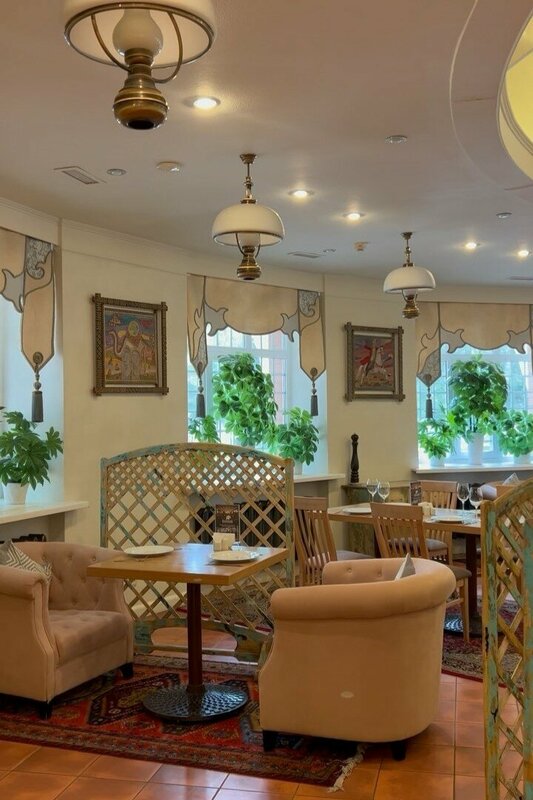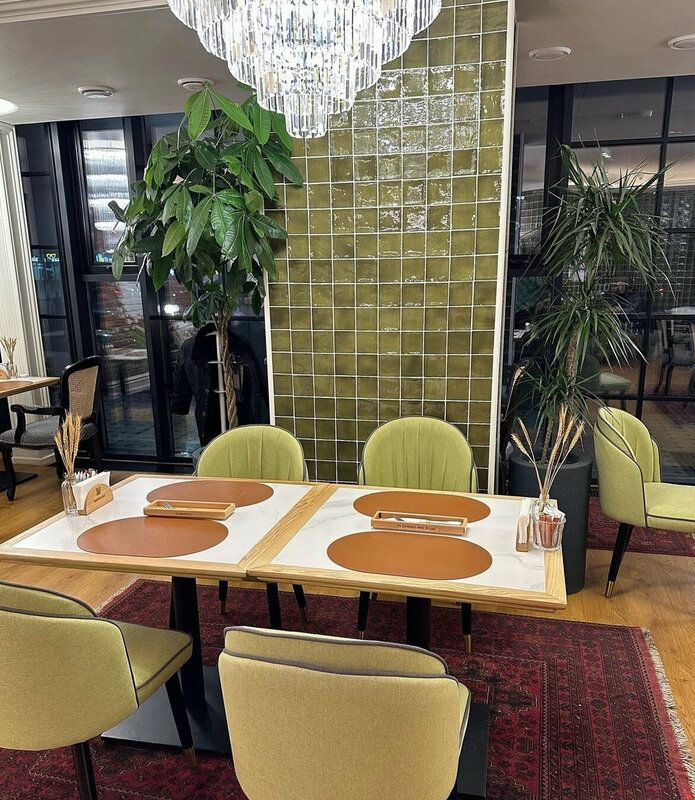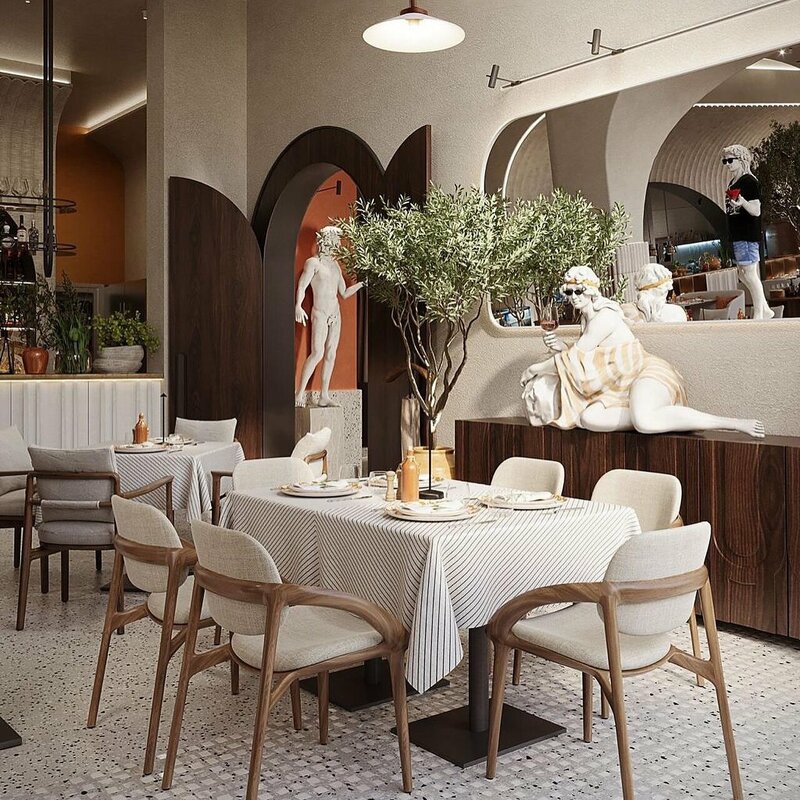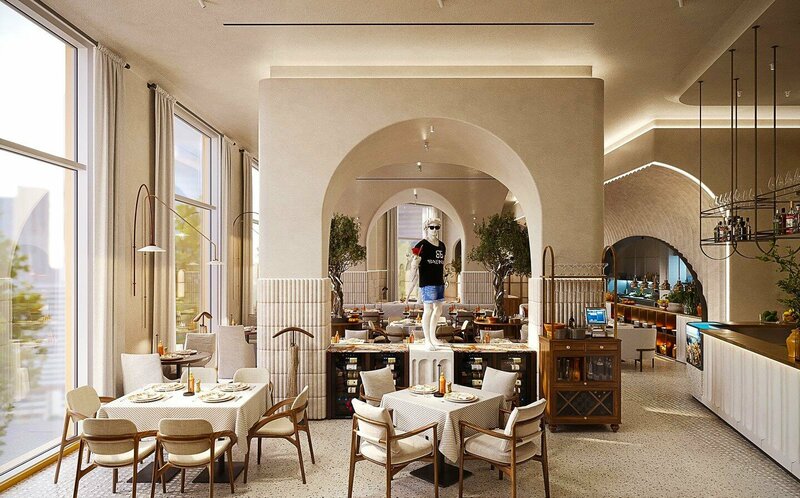
The veranda at Ali Baba, by the Farhi complex, is built like a modern Eastern tent: woven canopies, glowing lights, close-set tables and a steady rush of movement that lasts well into the evening. The mood is closer to a lively bazaar than a conventional restaurant — bright, noisy, animated, with the occasional sound of paradise birds cutting through the air. The menu keeps the same story going: Uzbek plov, lagman, kuyrdak, kespe, samsa, the house’s much-loved chebureki, and shashlik in every form — from the classics to kebabs.
Bakerist comes from the team behind Ginza and Kazburger, with Pavel Yefanov — formerly of Moscow’s Coffeemania — leading the kitchen. The idea is there in the name: a bakery with a serious coffee programme. Pastry is the quiet centre of gravity here. Croissants, tartlets and éclairs are made in-house, with the kind of attention to texture and freshness that turns a simple bakery counter into the main event. The terrace helps set the scene: spacious, softened by greenery, and just far enough from Mangilik El Avenue to feel sheltered from the city’s pace. Morning brings the movement of people and traffic around it. By evening, the light drops, the street slows, and the air carries the warm, unmistakable smell of pastry just out of the oven.
Another excellent angle for a beautiful social-media card is hidden here. Del Papa by abr, on Kruglaya Square, is one of the few restaurants in this location that has truly lasted: neighbours change, but it remains. The menu stays firmly within the Italian comfort zone: carbonara, cheese gnocchi, mushroom risotto, lasagne and tiramisu. The view does much of the rest — the glass arch, the fountains, the calm pedestrian route towards Baiterek. It slows the pace and makes staying longer feel almost inevitable. Come at sunset: a glass of Chianti, the light fading, the sound of water instead of background music — enough to make the evening quietly cinematic.
Dio Grand Cafe now has a glass-enclosed summer terrace overlooking Sarayshyk Street — a bright, polished space with crisp white tablecloths and an almost resort-like ease. Mornings here begin with house syrniki and farm kaymak, or millet porridge with slow-braised beef cheeks — ideally with a mimosa or bellini, and no particular reason to hurry on. Later, the menu shifts into something more substantial: kataifi prawns with wasabi sauce, house-made pasta with Kamchatka crab and chilli.
Eva Wine Cafe by Good Project is made for slow breakfasts with a view of Presidential Park. From the terrace, the trees sit almost within reach; inside, soft light and wine cabinets around the room give the space the feeling of a wine cellar reimagined as something warm, bright and quietly elegant. The kitchen, led by Azamat Rakhmetullayev, goes well beyond the usual wine-bar script. The menu moves from hash browns with trout to a Buddha bowl with quinoa, avocado and falafel, a croissant with ham and vegetables, and mini croissants served with vanilla milk. For dessert, there are syrniki with Burabay sea-buckthorn jam. And the spiced pumpkin latte with cheese foam makes a very good case for letting breakfast last a little longer.
Koktem.Bistro is the kind of place that stays in memory for its summer terrace first. A large veranda by the embankment is still a rarity in Astana: open air, greenery and enough space to lose half a day without quite noticing. The bistro carries on the legacy of Koktem, one of the city’s original breakfast names, and much of its pull comes from a serious pastry counter. The shelves move from classic croissants to vegan raisin swirls and sourdough loaves, including wheat and malt tartines with coriander. The menu keeps breakfast at the centre: Benedicts, scrambles with salmon and spinach, and all the familiar morning rituals done properly.
La Crème on Mangilik El Avenue is for mornings with no hurry built in: a veranda table, good coffee, and a brief step out of the city’s tempo. The terrace is generous and full of light — pale tones, comfortable armchairs, flower planters, sun, air, space. Breakfast is served all day, which feels exactly right here. The menu favours abundant plates: toasts, scrambles, fruit, cheeses. The signature La Crème breakfast arrives as a full spread — stracciatella, beetroot hummus, trout tartine and a series of smaller accents on one plate. The croissants are a reason of their own: from the classic to richer versions such as the Versal, with chicken in a nut crust. Add desserts and seasonal drinks, and breakfast easily stretches into brunch.
The defining feature of La Mia Piazza has always been its architecture: an entire little Italian street recreated inside the dining room, complete with façades, windows and the feeling of stumbling into a piazza somewhere far from Astana. But once the weather turns warm, attention shifts to the terrace. From here, Turan Avenue unfolds in full motion — traffic, lights, the city moving at speed — while the veranda itself somehow remains calm, suspended slightly outside the rush. That contrast is what makes the place memorable. The menu continues the Italian storyline with confidence: fifteen kinds of Neapolitan pizza, from the classics with mozzarella and basil to more unexpected combinations such as roast beef with pickles, alongside pasta, risotto, gnocchi and salads in the spirit of a proper trattoria. The wine list spans around 50 labels, moving from light Vermentinos to fuller Tuscan Chiantis, with a particularly good by-the-glass selection.
The right bank’s signature view is the Karaotkel Bridge, and La Rivière, the panoramic restaurant at The St. Regis, offers one of the city’s most elegant ways to take it in. On the terrace, white tablecloths and abundant light set a calm, hotel-like rhythm. Breakfast moves at an unhurried pace: porridges and syrniki for the classic route, or acai bowls with berries, French toast with cheesecake, and royal eggs with caviar for something more indulgent. Later in the day, the kitchen shifts between European and local dishes — fillet mignon, Norwegian salmon, and kespe with lamb samsa.
The tower on Kenesary Street is the oldest architectural landmark on the right bank — and part of Line Brew itself. In summer, the restaurant opens a large terrace hidden from the street, facing the courtyard: intimate, quiet, and almost cut off from the city. Inside, the mood is darker and more substantial — stone, dark wood, wrought-iron chandeliers. The menu follows with serious meat classics: dry-aged beef carpaccio, solyanka, entrecôte, ribeye, T-bone, stew and ribs.
At Loyo, Sergey Debilov — behind UlyDala Brewery and La Mia Pasta in Aktobe — builds a sharp European bistro menu: chicken-heart pâté, seasonal salad with stracciatella, fourteen kinds of pasta, from vongole to mushroom ragù, and pike cutlets with potato purée. Mornings can bring eggs served in porcelain ducks, with Emmental and pistachio mortadella. By evening, the kitchen turns more focused: tartare with capers and baked focaccia, sous-vide lamb shank, and other fuller, more composed dishes. It feels like a real city bistro: a busy street outside, the sound of traffic, tables set close, the room full of movement — exactly the kind of energy the format needs.
Marcello may have stepped out of The Chef Group and returned as Mari, but the feeling is still unmistakably familiar: the same veranda, the same kitchen, the same calm Italian-courtyard mood. In summer, the place really opens up. Greenery wraps the terrace, while glass shields it from the noise of Turkestan Avenue, giving it a rare sense of privacy in the middle of a busy stretch. The menu stays confident and well edited: guacamole with focaccia to start, frutti di mare pasta next, then the classics — Neapolitan pizza from the wood-fired oven, aglio e olio with prawns, and porcini risotto.
At Roastbeef, consistency is the signature. Year after year, everything runs with quiet precision; the menu barely changes, and that restraint feels less like habit than confidence. Set slightly away from the city’s busiest streets, the restaurant feels deliberately removed from the rush. The space is generous and composed: living hedges between tables, a glass veranda filled with light, views of the business district — and almost none of the city’s noise. The products are part of the interior: open wine shelves, dry-ageing cabinets with mature beef, oyster tanks — everything in plain sight. The menu stays loyal to confident meat-house classics: borscht, roast beef with mushroom sauce, prime steaks, and no unnecessary experiments.
In the old centre, on the grounds of Saltanat Sarayy, Salt Terrace brings a new open-air address to the season: a large green terrace under the sky, with music, easy movement and the kind of summer mood that makes evenings run longer than planned. The food keeps things clear and generous: chicken pâté, hummus with tomato salsa, brisket, smoked rib. The main accent is on the grill — ribeye, shashlik, sausages and fish, all cooked over coals.
Hidden inside the Europa City courtyard, Six Coffee+Wine has the rhythm of a place made for long days: espresso in the morning, wine by evening, and no real need to rush either. The summer terrace works like a quiet pocket away from the city — greenery, a small fountain, a pedestrian courtyard, the street held at a distance. Breakfast runs until 6pm, which is exactly the point: come when you like, order eggs with salmon, sit outside. Later, the menu shifts into comfort food. The clear local favourite is the schnitzel with melting cheese — generous, photogenic, and already doing its work on social media.
At Zina, the veranda has the same easy generosity as the restaurant itself: a glass-framed space overlooking a green courtyard and a small playground, made for long family tables. The menu is rooted in home-style cooking, with quiet Asian touches: broccoli with unagi, cauliflower with miso, pizza from a birch-wood oven, and bread made with a 40-year-old sourdough starter. The interior feels like a country house remembered from childhood — heavy furniture, mismatched plates, rugs, a fireplace, and small nostalgic details that make the place feel warmly lived-in.
If any place in Astana marks the start of summer, it is Koktem. As soon as the temperature moves past a comfortable 20°C, the terrace opens, morning pop-ups bring in DJs, and the café begins to live a little louder. The food keeps things simple, exactly as it should: scrambled eggs with prawns, borscht, homemade cutlets with mash, spaghetti Bolognese, a cheeseburger set with fries and a drink — nothing to distract from the main event: sun, park, city. The terrace looks straight onto Baiterek and the park. You can sit on the small lawn or gather at a table with friends. Silence is not really the point here: Koktem is made for movement, conversation and the kind of summer mood that feels instantly shared.
At Na Kryshe by Good Project, Astana opens in a single frame: the Ishim River, Zhetysu Park and the city’s landmarks laid out below. One of the capital’s original rooftop verandas, it still knows exactly why people come — for air, scale, and a view that turns dinner into an occasion. The menu stays European in spirit: ceviche, grill, pizza, pasta, bruschetta and charcoal-fired meat. The wine list gives the evening its backbone — more than 200 labels, led by Europe and New Zealand.
Images: restaurant websites and social media; Yandex Maps