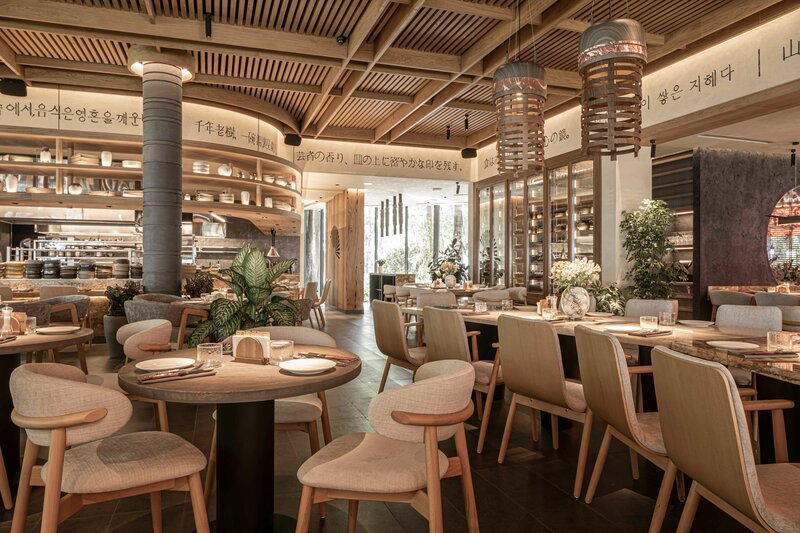
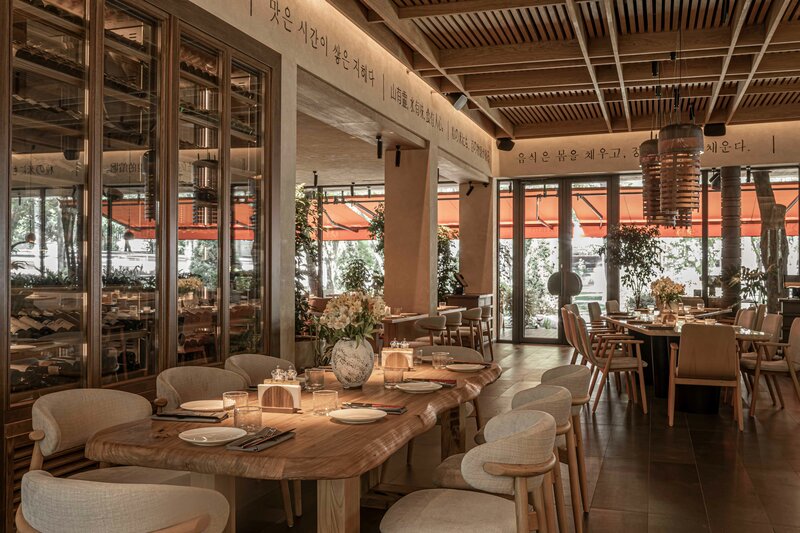
OKO, Zira, Oila, Zimmer
Ilkhom Khudoyberganov grew up in Khorezm, where food is not merely a daily necessity, but part of a culture’s living memory. His career, however, was formed far from home. In St Petersburg, he moved from entry-level restaurant work to the kitchens of the Four Seasons and a collaboration with the team at Birch. The European training sharpened his command of balance, texture and ingredient-led cooking. Returning to Uzbekistan gave him a way to apply those lessons to the flavours he had known since childhood.
Khudoyberganov’s work offers a persuasive sense of where Uzbek gastronomy might travel next. Modernity does not require taking plov apart at the molecular level. Sometimes it lies in understanding what makes a familiar dish work in the first place — then giving it a new grammar.
Tashkent has always known how to feed people well; that much is beyond dispute. Yet only a few years ago, the capital’s culinary ambitions rarely strayed beyond a familiar formula: generous portions, handsome tableware, an interior designed to look suitably expensive, and a menu where plov, Caesar salad, sushi and spaghetti carbonara coexisted in perfect harmony. With cream, naturally. The Italians might have objected. No one, however, went home hungry.
The more revealing part of Bychkov’s work is not any one dish, but the structure behind it: his ability to shape markedly different restaurant concepts without allowing the cooking to lose its recognisable standard. A plate can shine at a one-off tasting. The harder business is ensuring that it is made as well on the hundredth occasion as on the first.
Tokyo, not recast for Tashkent
The rules, however, are beginning to shift. More and more, a restaurant dinner is an occasion not merely to eat, but to encounter a chef’s way of seeing produce, culture and the very notion of taste. Local ingredients, traditions reconsidered, experience gathered abroad — and, sometimes, the confidence to remove all that is superfluous from the plate: these are the new coordinates. That, perhaps, is the clearest sign of a more discerning dining culture: Tashkent is beginning to care less about how much is on the plate than about what has been done with it.
Kitana is included in Ultima Guide 2026’s selection of Tashkent’s best restaurants.
He spent more than a decade in Moscow, including with Novikov Group projects, developing his knowledge of Chinese and pan-Asian cooking, seafood and the standards of premium dining. In 2025, he returned to Tashkent and joined the Kitana team.
The chef with no use for culinary boundaries
Both 12 and Ora feature in Ultima Guide 2026’s selection of Tashkent’s best restaurants. Ora also received special awards for Outstanding Service, Best Interior and Users’ Choice.
After kitchens at Moscow’s White Rabbit and Beluga, he now brings that sensibility to Tashkent’s 12 and Ora. At Ora, the author’s sets are shaped as carefully paced experiences: not only what is cooked, but how each impression is allowed to unfold. Salmon with three kinds of caviar; beef rib with buckwheat popcorn — dishes in which familiar ingredients find unexpected company.
Experimental cooking demands restraint. One superfluous ingredient can be enough to tip a dish from a genuinely compelling idea into something made only to photograph well. What makes Kurbonov’s work interesting is his pursuit of the balance between effect and substance.
Tashkent’s growing appetite for seafood asks for a particular kind of discipline — logistics, the quality of the raw product, storage and handling all have their part to play. Fish tells on a kitchen. Sauce and a heavy hand with spice can disguise plenty, but good seafood begins long before it is served.
Asia, without the culinary grand tour
Childhood memory, rendered in the idiom of contemporary cooking
The chefs featured here each move that change forward in their own way. This is not a ranking, and there are no medals at stake. Their cuisines, philosophies and ideas of what a modern city should taste like are entirely their own.
Kitana
Pan-Asian cooking has long been at home in Tashkent. The label can, however, conceal a curious collection of anything remotely Asian: sushi, tom yum, noodles, poke and the obligatory sweet chilli sauce. Shakhzod Tukhtayev takes a more exacting view.
At Kitana, Asian cooking speaks in the language of technique: the wok, the grill, the exact calibration of heat, texture and sauce. Balance is the governing principle. Heat is never allowed to smother the ingredient; acidity is there to sharpen, not to perform; and seafood, cooked properly, requires no concealment. Perhaps this insistence on proportion is what distinguishes the real thing from its many stylisations.
Food and theatre have always shared a border. At one, a programme is handed out; at the other, a menu. Kurbonov’s work rests on the understanding that a modern restaurant can offer far more than a sequence of courses.
Both OKO and Zira appear in Ultima Guide 2026’s selection of Tashkent’s best restaurants. In February 2026, Nikita Bychkov received WhereToEat Uzbekistan’s Chef of the Year title.
At Bazar, this idea is played out with particular clarity. Eastern cooking is neither frozen in aspic nor cut adrift from its roots. The chebureki make the point neatly: a dish shaped by the chef’s childhood memories, recast through the language of a contemporary kitchen.
Kaspiyka
The difficulty with adapting a national cuisine to local preferences is that, somewhere along the way, it can cease to be itself. Atsuto Uchiyama, the chef at Furusato, offers another way.
Furusato features among Ultima Guide 2026’s top selections.
When the kitchen has a director
Some chefs are defined by a single cuisine. Nikita Bychkov is not. His work moves easily between very different worlds: OKO gives contemporary cooking a vivid Asian inflection; Zira is more relaxed and geared towards everyday dining; Zimmer takes on the altogether different energy of the city after dark. The common thread is a simple one. Familiar ingredients are reimagined, never overwhelmed — and flavour remains non-negotiable.
Kaspiyka is also included in the latest Ultima Guide.
Bazar
More than a decade spent working in Tokyo and Yokohama has informed his approach. Rather than trying to anticipate how Japanese flavours should land with a Tashkent diner, he brings the city a more traditional expression of the cuisine. Ramen, tempura and kamameshi; authentic ingredients; scrupulous attention to the quality of the broth. Here, fidelity of execution takes precedence over visual theatre.
Furusato
This, too, shapes the capital’s culinary culture. An encounter with another cuisine need not begin with simplification. Sometimes, gastronomic curiosity asks us to meet unfamiliar flavours halfway.
Uzbekistan sits in an unusual geographical position: to reach open ocean, one must cross at least two national borders. Fortunately, a serious fish kitchen does not need to be on the coast.
Seafood in a landlocked city
By making seafood an everyday proposition rather than a special-occasion flourish, Kaspiyka — with Alyona Ivakhnenko leading the kitchen — is quietly reshaping the city’s dining habits.
12, Ora
Space for a new palate
Nachalo
A contemporary restaurant must resolve a small paradox: it needs to know exactly who it is, yet leave enough room for each guest to find their own way into it.
Nachalo wears its affinity with contemporary art openly. It points to a wider change in Tashkent, where restaurants are increasingly becoming participants in the city’s cultural life rather than merely places to convene over dinner. But striking design is not what makes a chef great. The question begins — and remains — in the kitchen: can the restaurant carry its idea from room to plate, and retain a guest’s curiosity beyond the first visit?
Food without the grand gestures
With chef’s tasting menus, intricate technique and dining turned into theatre, it is easy to lose sight of a simple fact: most people go to restaurants to eat.
Shukhrat Ishankulov, the chef and founder behind Fillet and Zaytoon, represents another important direction in the city’s restaurant culture: cooking that is clear, assured and pleasurable without requiring a lengthy explanation. Modern comfort food has long ceased to mean unsophisticated food. If anything, the plainer a dish appears, the more difficult it can be to execute with consistent quality.
That matters especially in a growing restaurant market, where new culinary ideas need to belong not only to special dinners, but to the everyday life of the city.
These chefs have arrived here by very different routes. Together, however, they are opening up a choice more consequential than simply where to eat: Tashkent diners can now choose between distinct culinary ways of thinking. Japanese classics; Eastern dishes seen anew; a chef’s set menu; or a perfectly cooked piece of meat — the city has room for all of them.
The real achievement of this new generation is a gastronomic identity that belongs to Tashkent alone. It has not been imported wholesale from Moscow, Paris or Tokyo, assembled from Pinterest boards, or conceived in a restaurant group’s latest strategy session. It is emerging from respect for tradition, curiosity about the new and, perhaps best of all, increasingly exacting expectations of quality.
For years, Tashkent’s culinary calling cards were plov, samsa and the generous rituals of an Eastern feast. They remain — thank God. But the city can now tell a richer story. Contemporary gastronomy is not about replacing familiar flavours with fashionable new ones. It is about giving that story new chapters: ones people will want to follow, taste and keep writing.
English edition by Yevgeniya Yussupova
Fillet, Zaytoon
Photos: restaurant websites and social media; Yandex Maps
There is another force shaping Tashkent’s food scene: the people at the table. Diners now travel, taste and compare. A handsome plate no longer passes automatically for value, and that is excellent news for the industry. A more demanding audience raises chefs’ game; better cooking, in return, sharpens the audience’s palate. It is a virtuous exchange.