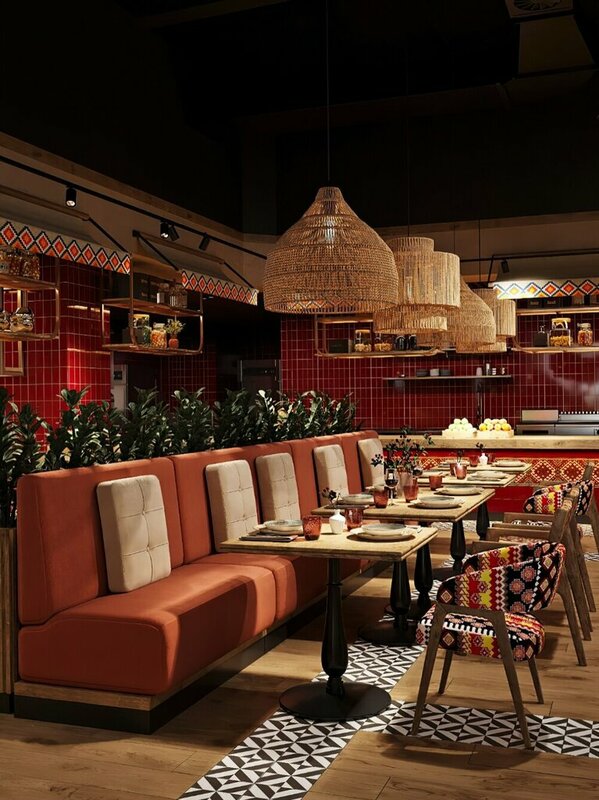
The concept is built around the idea of a lively, welcoming Georgian home, where contemporary service meets quietly authentic detail. Overhead, large straw-and-jute chandeliers sway gently, their form subtly recalling traditional papakha hats, while the walls are animated by painterly scenes of Georgian village life. An open kitchen, dressed with strings of dried peppers and an abundance of seasonal vegetables, sits alongside panoramic windows that fill the space with soft light. Chairs upholstered in bright ethnic patterns and elegant felt panels complete the picture of southern hospitality. The menu brings together all the familiar classics — from khachapuri to satsivi — while also making room for more curious, author-led dishes, such as black khinkali with shrimp.
Khinkali: 48,000 UZS for three
The presentation has a touch of theatre to it: at the table, the waiter finishes the plate with freshly ground pepper from an oversized mill. We counted 12 pleats. The dough is exceptionally thin, yet elastic enough to hold its shape, concealing a generous pocket of fragrant broth. The filling is boldly peppered — tender, moderately rich meat threaded with fresh herbs and flashes of red chilli — and leaves a vivid, savoury aftertaste. A firm topknot makes it easy to keep to the classic etiquette, though in this case it feels less like obligation than instinct.
The concept behind this Georgian neo-bistro rests on a light, gently ironic reading of tradition. The space is done in a palette unusual for the genre — shades of blue, pink and white, where fluffy pink chandeliers sit alongside weighty timber columns. Near the entrance, guests are met by an open kitchen, its oversized pots sending up thick clouds of steam that all but announce the arrival of the house specialty, while above the extraction hood a declaration of love to Tashkent is written in Georgian. Tableware patterned with national motifs and knotted wall compositions lend the room a particular kind of domestic polish. The menu brings together traditional recipes and more contemporary culinary instincts, offering both familiar classics and author-led starters with an emphasis on fresh vegetables and cheese.
Khinkali: 51,000 UZS for three
The khinkali here, topped with a miniature flag bearing a playful inscription, show an almost jeweller’s precision in their construction: we counted 17 neat pleats on each one. They may also be finished at the table with pepper from a large mill. The dough has a more assured structure to it — firmer, more deliberate, and likely to appeal to those who favour substance over softness. The khinkali themselves are slightly smaller in scale, their filling gathered into a denser centre rather than a looser, juicier one. The broth is less abundant than one might hope, but the overall flavour remains composed, balanced, and very much in step with the restaurant’s more contemporary sensibility.
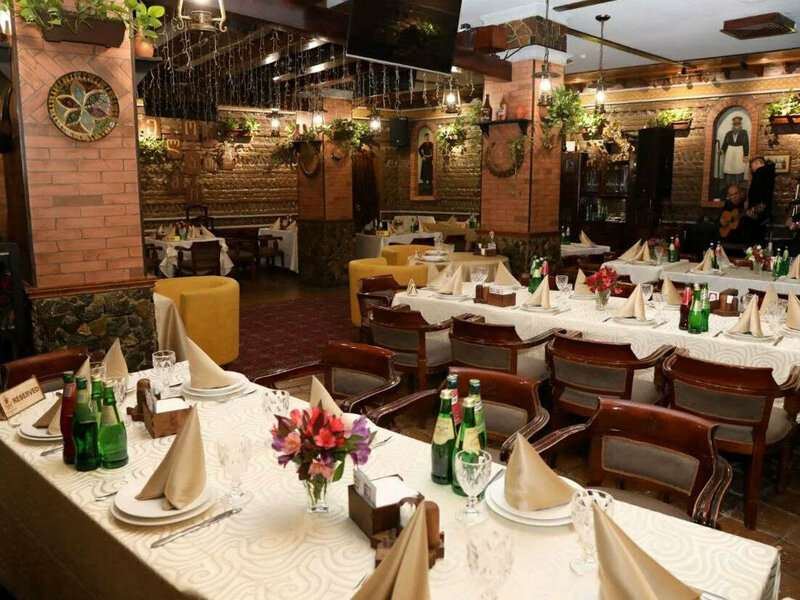
Part of Caravan Group, Gruzinsky Dvorik is widely regarded as one of the restaurants that first established Georgian cuisine in Tashkent, and it continues to hold that position with the kind of quiet authority that comes from time, consistency, and absolute confidence in its own identity. The project grew out of family tradition and an unforced sense of hospitality. The interior is classically composed, generous in stone and wood, with no interest in passing fashions. Nor does it need them. Its reputation has long spoken for itself, drawing a loyal clientele back for decades. The menu follows the same assured line, bringing together the essential canon of Caucasian cooking — from deeply spiced sauces to meat cooked over open flame, handled with confidence and restraint.
Khinkali: 75,000 UZS for three
The khinkali at Dvorik come closest to a platonic ideal for those who value depth of flavour above all else. We counted 18 pleats, drawn tightly around a filling that is both succulent and deeply expressive, with a faint but unmistakable suggestion of the grill — a nuance that lends the whole thing a more vivid, savoury complexity. The broth is concentrated, resonant, and unmistakably meaty, with an aroma that arrives just ahead of the first sip. And although the filling is more firmly gathered than in some other versions, it remains impressively juicy. Of all the khinkali we tried, these felt the most firmly anchored in tradition — the ones that came closest to capturing the spirit of a true Georgian feast.
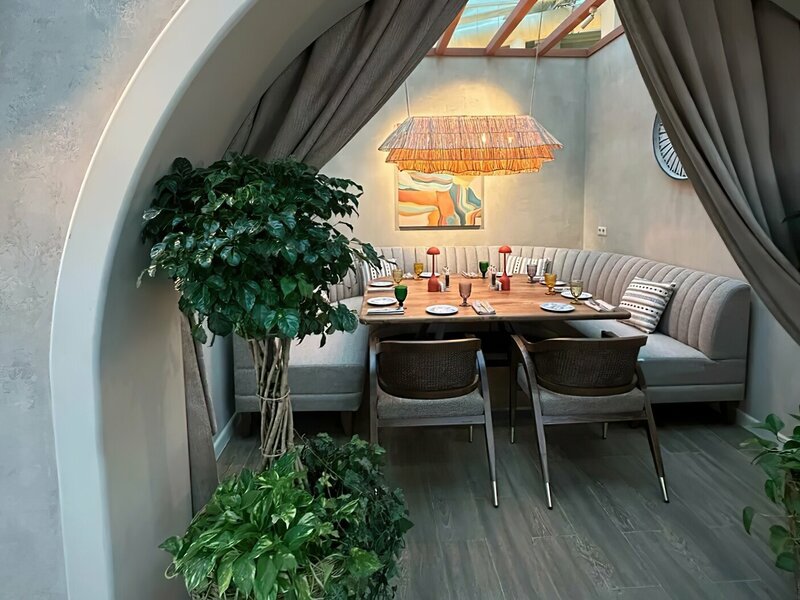
Shvili occupies a privileged address in the very centre of Tashkent, within the New Kuranty building overlooking Amir Timur Square. For a restaurant set in such a prominent corner of the historic centre, its pricing feels notably, and pleasantly, accessible. The room is filled with light, air, and living greenery, at the centre of which a fountain murmurs beneath finely wrought copper birds. Pomegranate-shaped lamps and woven decorative elements lend the space the atmosphere of a shaded garden — somewhere that encourages lingering rather than haste. The menu brings together traditional Georgian starters, richly developed soups, and a generous selection of dishes from the mangal.
Khinkali: 47,700 UZS for three
The presentation stands apart in the way the khinkali are laid horizontally across the plate, a choice that draws attention to both their shape and their appetising poise. If desired, they can be finished with freshly ground pepper from an oversized mill. The filling is notably lean, threaded with generous flecks of fresh herbs and evenly distributed rather than gathered into a dense centre. A delicate wrapper, folded into 12 pleats, holds a generous amount of richly flavoured broth with remarkable assurance. The overall effect is light and elegant, yet deeply satisfying — a version in which each ingredient registers clearly and on its own terms.
This small, intimate restaurant carries guests into the atmosphere of a welcoming Tbilisi apartment. The walls are dressed with carpets and mirrors, the tables laid with festive cloths patterned in national motifs, while the open kitchen allows a clear view of dishes taking shape as they are prepared. The emphasis here is on food that is simple and honest — free of pretension, yet full of warmth.
Khinkali: 54,000 UZS for three
Here, we found the most generous proportion of all: an ideal balance between a substantial filling of succulent meat and a fine, delicate wrapper. The filling, rich enough to register yet never excessive, is threaded with plenty of aromatic herbs and accompanied by an ample measure of deeply savoury broth, securely held within 15 pleats. It is the kind of khinkali that reminds you how quickly modest scale and outward simplicity recede when the food itself is this convincing.