Editor-in-Chief, Dine Out @ Yandex Eats International
When I’m out walking with my child, I choose Aqqu — the most genuinely baby-friendly place in the city centre. First, there is a mother-and-baby room, which is rare enough to deserve real respect. Second, the space is pleasantly roomy, with little corners where a child can sit down to eat as well. Third, the fountain works better than any white-noise device. For a quick, reliable hit of dopamine, order the wafer rolls or oreshki with condensed milk. I also keep coming back for the naval-style pasta — a very good take on a nostalgic classic, with a slight cacio e pepe logic to it.
For breakfast, Fika: reliably good, with a stylish crowd around you and pastries in the display case that are dangerously habit-forming. For dinner, Ogonyok — an easy win, because consistency is the point. For communion with a book, a plate of pasta and a glass of wine, the tiny, less obvious terrace at Monte Bianco. For sheer beauty, Rifugio del Monte. For the soul, the Venice shashlik house.
Travel blogger and event manager
The terrace at Astra Grand Cafe has that rare away-from-the-city feeling, even while you are still in it. Everything is composed: calm, beautiful, quietly expensive — a small passage out of the rush and into a more polished version of the day. Cafe Alma, in the city centre, carries old Almaty with a modern pulse. The breakfasts are excellent, the warmth feels genuine, and the place has its own gentle charm. Come for the city’s mood: take a table on the veranda, order coffee, tea or one of the special cocktails, and let the moment do the rest.
The terrace at Osobnyak feels like the garden of a Sicilian villa: lemons, greenery and sun-warmed details that make the evening feel instantly southern. I love the holiday mood of it — even on a weekday, it has that rare ability to make the city fall away. The perfect order is simple: oysters, a glass of prosecco, and a beautiful evening left to unfold.
For a proper escape, Rifugio del Monte is the answer: mountain views, clean air, and the kind of stillness that resets the whole day. The food holds its own too, which matters — atmosphere is always better when the kitchen can match it. Cafeteria on Kurmangazy is one of Almaty’s great summer constants: busy, bright, unmistakably urban. It has the rhythm of the city in full swing.
Fashion blogger and art director
My great love is the courtyard terrace at Cafeteria. It has a distinctly Italian ease: soft light slipping through the trees, a quiet warmth in the air, and the feeling of a small European café tucked away from the city. I used to come here almost every day — for breakfast, meetings, the usual working rituals — and it still feels tied to something warm, familiar and beautifully unforced.
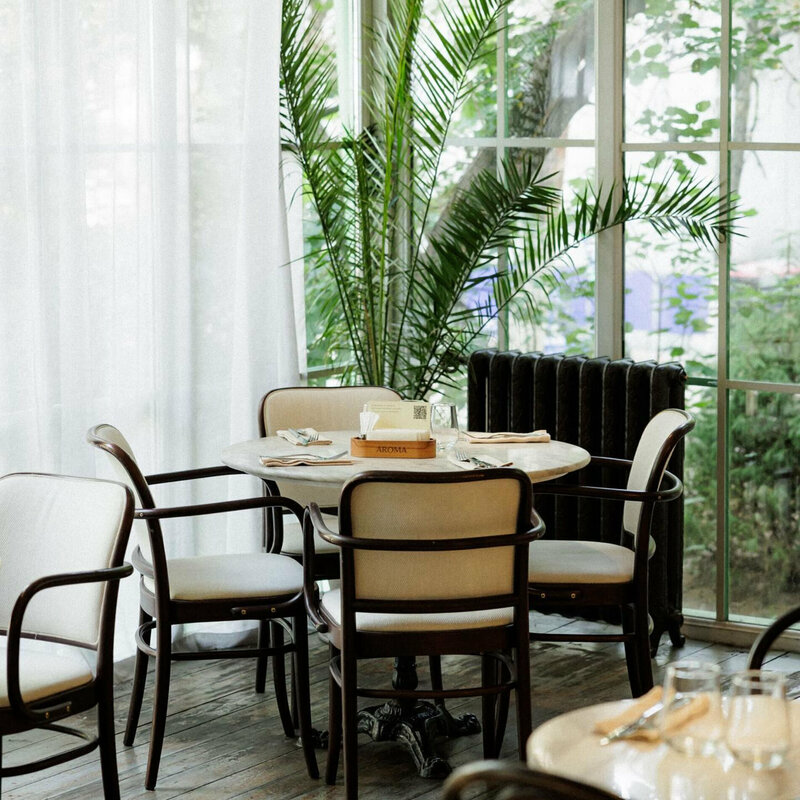
Aroma is another place with a distinctly European mood — I can’t help it, I’m devoted to the idea of a European summer. Time seems to slow down here a little. There is a light Italian feeling to it, the calm rhythm of city life around you, and the sense that you could order a glass of prosecco and not hurry anywhere. And it is hard to describe how beautifully the sunlight falls across the green façade. In moments like that, everything feels warmer, softer, almost cinematic.
I fell in love with Aqqu on a rainy summer day, over brunch with a friend. The rain had just passed, the air felt newly washed, and the terrace was still a recent addition — small tables set along the sides, sheltered from the weather. We ordered coffee and our favourite condensed-milk wafer rolls, then sat outside. Dense greenery, the smell of summer rain, birdsong — everything felt unusually still, as if the city had briefly softened around us. On crowded, overfilled days, that is what brings me back: the quiet, the calm, and the almost domestic warmth of the place.
Fashion blogger
For me, Afisha is the city centre in its truest sense: the Opera House nearby, the air somehow different, culture not as a concept but as a feeling. I love the second-floor terrace most. From there, everything comes into view — Arbat, the Opera, the mountains — and Almaty reveals itself differently. I come here in different seasons and moods: for lunch in spring, when the city feels soft and calm; and on summer evenings, when everything is full of light and life.
Aqqu is part of my personal history. I came here as a child, later as a student, and I still come now — this neighbourhood has become one of the quiet backdrops of my life. So many firsts happened here: first love, first adult conversations, the first real taste of freedom and lightness. When I return, there is always this strange, deeply tender feeling — as if I am meeting the younger version of myself.
Korkem Gourmet is more about a state of mind, about the way I feel inside this city. Sitting there, with birdsong around me and old trees overhead, I sometimes slip back into childhood — into a time when everything felt simpler, softer, calmer. Especially in summer. And when the fountain is on, and the sound of water mixes with leaves and voices, you can simply sit there, do nothing, and feel yourself slow down. I love it for the people, too. There are always locals here — people who have lived in the neighbourhood for years, not passing guests, but part of the city itself. In moments like that, I feel it sharply: I am from here.
Lifestyle blogger
What does an Almaty local need once spring turns warm? Good weather, a shaded terrace, proper coffee and something beautiful to look at. One of my favourites is Julius on Kabanbay Batyr: the Opera House in view, the park nearby, stylish passers-by moving through the frame. Another is Aqqu — just as picturesque, with the added weight of local history. On hot summer days, you sit by the fountain with a book and a coffee, and slip into the Almaty our parents knew when they were young. Perhaps the park will even bring the swans back to the pond one day, as it did a few years ago. I would also add Café Alma. Choosing between the Tulebayev branch and the one by the Museum of Modern Art is almost unfair — each has its own charm.
In the end, the overlap says the most. The list narrows quickly — Aqqu, Cafeteria on Kurmangazy, Café Alma, Rifugio del Monte — and becomes sharper for it. These are the terraces named by people with different lives, different rhythms, different reasons for loving the city, yet the same instinct for where Almaty feels most like itself. What connects them is not cuisine or format, but feeling.
There is an insight in that, too: people who shape the city’s taste rarely chase novelty for its own sake. They return to places with a stable emotional atmosphere — places that deliver the same feeling every time. And almost no one speaks only about the food. What comes first is mood: comfort, aesthetics, the visual experience, the chance to slow down for a while.