Italian restaurants tend to conjure checked tablecloths and lemons. Giotto takes another route, building its interior around unexpected forms and contrasting textures: a spiral staircase, satellite-like chandeliers, wooden armchairs and leather banquettes. The menu includes more than 20 pizzas, alongside pasta, panini, and meat and fish steaks. Dessert brings waffles, several kinds of cheesecake and the house gelato in a range of flavours.
With its Art Nouveau interiors, Sirius calls to mind the grand hotels of cinema — fittingly, as it sits within the East Star Hotel. Velvet seating, formal table settings and the softened glow of elegant chandeliers provide an apt setting for an evening outfit and a date to remember. The menu has room for every appetite: sushi and Thai-style prawns; steaks and beef stroganoff; pho bo and tom yum; pasta and ravioli.
Contemporary in its overall language, the restaurant near Amir Temur Square is anchored by the work of Uzbek artisans and local materials. Its chandeliers were blown by local glassmakers; the camel canvases are by Tashkent painters; and the dessert counter incorporates Nikolayev brick salvaged from a demolished house in the city. At the open kitchen, tartare, carpaccio, pasta, brisket and ribeye are prepared in view. Bread is baked on site; dessert is San Sebastián cheesecake.
Near Youth Park, Bellis takes its cues from classic interiors: ornate mirrors, burst-shaped chandeliers, columns, and wrought-iron latticework dotted with lanterns. By evening, the lighting gives the room a distinctly romantic glow; at weekends, live music enters the equation. The menu moves easily through an international repertoire — oysters, salads, rolls, and meat and fish from the Josper. The final notes are honey cake, Napoléon and tiramisu.
English edition by Yevgeniya Yussupova
Near Dinamo Stadium, this Uzbek restaurant evokes an Eastern caravanserai. Light floods the room, where sofas are piled with embroidered cushions, fringed lampshades, vases and a woven ceiling. Several themed corners have been set aside for photographs, with illuminated reliefs, dastarkhans and carpets. The menu follows tradition: kurdyuk, dumgaza, jiz, mastava and mangal sets, served in portions of unmistakable Eastern generosity.
Near University Boulevard, Merci is built on contrast: cobalt walls, armchairs in ultramarine and fuchsia, gilt decoration, panoramic windows and designer chandeliers. The menu stays with European standards — bruschetta, Caesar salad, salmon in a creamy caviar sauce — alongside vividly coloured rolls and cocktails in tall glasses.
Photography: restaurant websites and social media; Yandex Maps
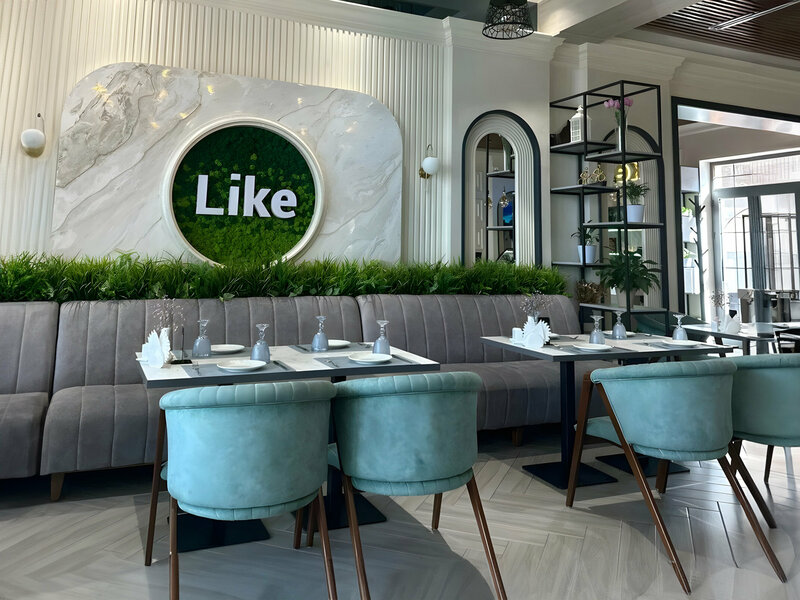
The room earns its like before you have properly stepped inside. Graphite and azure set the palette, with marble-effect walls and living greenery completing the scene. Its defining detail is a bas-relief of a woman. The menu claims no single culinary nationality: rolls, pizza, udon, köfte and jiz all make an appearance.
Just beside Central Park, this small café has the air of a white country cottage, terrace included. Inside, a pastel palette is interrupted by brighter gestures: pink walls, illustrated details, and a ceiling patterned to resemble sound waves. The menu has no interest in borders. Beef stroganoff, pizza and pasta sit alongside udon, sushi, kuksi and borscht. In the dessert case: croissants, pastries and cakes with designs on your camera roll, your heart and your stomach.