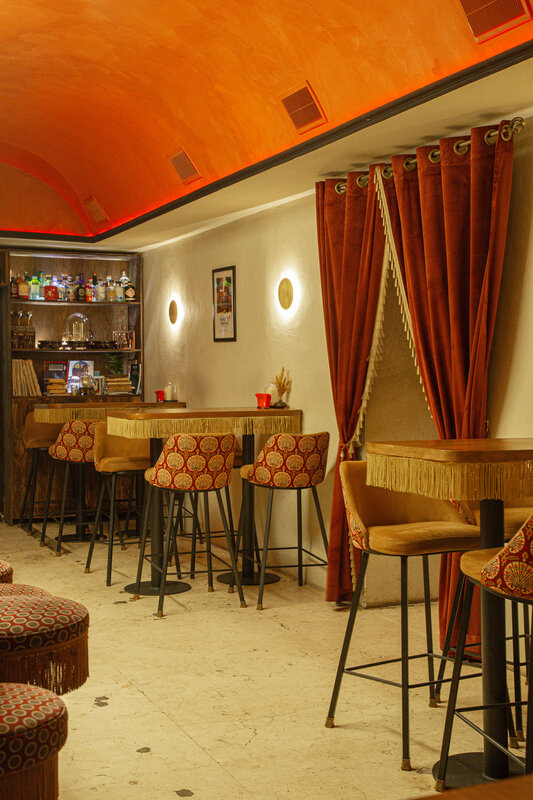
Once upon a time, meeting friends almost automatically meant a hangover the next day. Now, a coffee rave, a matcha party, a tea tasting or a special weekend bun might just as easily be the occasion. By now, it seems everyone has written about Gen Z bringing the alcohol industry to its knees. Does that mean bar-hopping is a thing of the past? Hardly. It is simply no longer necessary to leave the room spinning. Any bartender worth their salt can mix a mocktail with a complex flavour profile, rather than serve up yet another lemonade — thank you, non-alcoholic spirits. And in the surroundings of an award-winning bar, a health-conscious choice need not come at the expense of pleasure. Quite the opposite: a new wow experience may be waiting at the counter.
Whether millennials are in on the post-ironic joke is another matter. Gen Z, meanwhile, has taken culinary mischief to new heights: invite friends to dinner at the Qaganat cafeteria chain for a laugh, then discover that the food is actually quite good. Or head to Komok, where, in place of elaborate gastronomic revelations, the menu offers «fries» and mashed potatoes with meatballs. Non-alcoholic beer, as we have already established, is non-negotiable.
Alongside all this, hyperspecialisation is having a moment. Gen Z seems distinctly wary of places that try to sell burgers, sushi and pasta all at once. A menu devoted entirely to sandwiches, on the other hand? See Sangwich Club. Or take matcha bars such as Match. a. Single-product concepts are clearly winning this particular battle — not least when it comes to Gen Z’s finances. The bill at places like these is considerably easier to take.
And, naturally, all of this has to look the part. Gen Z has had its fill of sterile beige interiors and impeccably polished social feeds. Hand-drawn logos, deliberately rough graphics, unusual packaging, audacious merch? Yes, please. Special respect goes to the charmingly wonky «blend» on the logo of the «Shanghai» coffee shop — and to the nerves of steel behind it.
English edition by Yevgeniya Yussupova
Behind all this faintly comic seriousness lies an entirely understandable impulse: the pleasure comes not only from the product itself, but from knowing more about it. Still, it would be unfair to dismiss the whole thing as snobbery. There is something to be said for knowing exactly what you are paying for and whose work you are supporting. The ideal sommelier, after all, can speak not just about a winning pairing but about the finer points of a region’s climate. The barista — preferably with a championship title to their name — knows the farmer who grew the beans for your V60. Credit to millennials for taking those first steps towards more conscious consumption.
They watched Harry Potter grow up and third-wave coffee shops come into their own. The latter ushered in a more attentive approach to food and drink: being well versed in coffee, wine and seasonal produce became almost as much a point of distinction as knowing one’s way around an art collection. Provenance, in other words, became a detail worth spelling out. If the tomatoes in your bowl hail from Tashkent or the trout from Talgar, expect the menu to tell you so.
Large parties have given way to smaller communities. Opening a fashionable coffee shop is no longer quite enough; the more interesting proposition is to bring together people who have something to talk about beyond the menu. Runners gather at Collab for an Ethiopian filter coffee after a run through Almaty, while vinyl enthusiasts listen to favourite records over dinner at Unapasta. Very analogue indeed. In fairness, millennials — whose youth was spent at rather more raucous parties — have taken up running and keeping an eye on their protein intake, too. But that is another story.
A generation that mastered the swipe before handwriting might reasonably have been expected to move its social life online for good. Gen Z, it turns out, has other ideas: meeting strangers across communal tables and embracing all things analogue. Millennials were once the subject of jokes about reinventing the obvious. Gen Z, frankly, has gone one better. At Table, diners mark their choices on the menu in pencil — a thoroughly digital-detoxed affair. The playful concept offers a neat return to offline roots.
The eldest millennials are now in their forties, and the endless pursuit of culinary discoveries, new knowledge and the perfect aesthetic is gradually giving way to quieter pleasures. Like returning to a café you loved ten years ago and ordering your favourite breakfast without so much as glancing at the menu. These days, that has a certain luxury to it, too.
Photography: restaurant websites and social media; Yandex Maps
It is a little early to predict Gen Alpha’s culinary future: the oldest members of the generation are only around 16. What is already clear, though, is that their introduction to new foods often happens well beyond supermarkets, restaurants and cafés. According to analysts, more than half of the parents surveyed buy their children food they first discovered on television or online.
One thing is clear: in the age of short-form video, it is no longer enough for food to be photogenic. It helps if it knows how to perform. Crunchy Dubai chocolate (praise the culinary gods, we made it through), stretchy mochi, bubble tea with popping pearls — one suspects Gen Alpha may retain its appetite for sensory adventures well into adulthood. For now, of course, that is only a guess.
Millennials also made an art of documenting their lives — and making them look good. Enter #foodporn and the VSCO filter: breakfast was photographed from directly overhead, with Murakami, Ray-Bans and other artefacts of the age arranged around the plate in carefully studied disarray. It was a moment.
Little wonder that cafés became more than places to eat and drink. The American sociologist Ray Oldenburg had a name for spaces like these: «third places» — neutral territory, neither home nor work. The idea was around long before millennials, but independent speciality coffee shops and the rise of remote work gave it fresh currency. Here was somewhere to meet, work, read or while away a few hours over a single cappuccino — much to the owner’s dismay, it must be said. And, for the tech crowd, there was always a meetup to drop in on.