Ask almost any Kazakh where to find the best beshbarmak and the answer will be the same: at home. Every family has its own way of choosing the meat, preparing the sorpa and making the traditional delicacies served alongside it — kazy, shuzhyk, zhal and zhaya. Many still roll the dough by hand, though these days ready-made zhayma can easily be found at local markets.
For a classic beshbarmak, head to Nesibe, where it is prepared the traditional way: with horse meat, a rich sorpa and kurt.
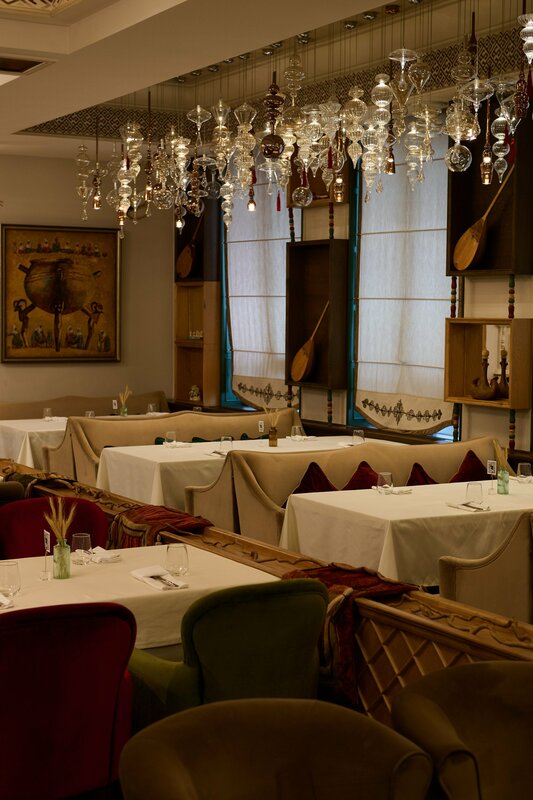
For a more refined take on Kazakh cuisine, book a table at Qazaq Gourmet. Here, Qazaq Eti offers several interpretations of beshbarmak made with horse meat, including one with truffle, while fishbarmak reworks the classic with sturgeon.
Kazy is a traditional Kazakh delicacy made from whole cuts of meat and fat from the horse’s ribs, packed into a natural casing to create the distinctive marbling visible in every slice. The recipe goes back to the nomadic era, when preserving meat mattered as much as making it nourishing enough to sustain long journeys.
No proper platter of beshbarmak is complete without the classic version. At Tor, however, kazy takes a different form: slowly cooked in its own juices and served on the bone, steak-style.
Chances are, baursaks will be among the first Kazakh specialities you are offered in someone’s home. Small rounds of yeasted dough, fried until golden, they arrive at the dastarkhan before the main course, accompany tea and are a fixture of every family feast.
For the most unexpected take, head to Bauyrdaq. Here, the humble baursak becomes a burger bun, filled with beef, lamb liver or kazy — an unlikely combination that brings traditional Kazakh flavours neatly into a contemporary format.
Ulpershek is one of the most distinctive dishes in Kazakh cuisine, with a story as tender as the tradition itself. Made from horse heart, it was traditionally preserved in flour for around a month. According to legend, mothers would send ulpershek to their married daughters as a quiet reminder that, however far from home, they remained close to their hearts.
Fat-tailed lamb fat is one of the defining ingredients of nomadic cuisine. Valued for its nourishment, its ability to keep well and its distinctive richness, it has long been part of the Kazakh culinary tradition — and is now appearing with increasing frequency on contemporary restaurant menus.
At Sandyq, quiryq mai is lightly smoked and served with kumis. The smoke lends it a deeper, more pronounced flavour, while the gentle acidity of the fermented mare’s milk balances its richness. Elsewhere on the menu, an entire tiskebasar section is dedicated to traditional appetisers and delicacies, with plenty to satisfy even the most particular guest: from quiryq-bauyr, the ceremonial pairing of fat-tailed lamb fat and liver, to mi palau, a Kazakh pilaf prepared without grain.
Photography: restaurant websites and social media; Yandex Maps.
At Daididau, the old recipe is approached through a contemporary lens. The heart is cooked sous-vide for 12 hours, then served with risotto and fresh herbs. The story remains untouched; only the way it reaches the table has changed.
At a good restaurant, there is usually a sommelier to navigate the wine list. Qazaq Gourmet, a fine-dining restaurant dedicated to Kazakh cuisine, takes the idea a step further with its own sabadar — a specialist who serves kumis and introduces guests to the many ways in which it can be made and enjoyed. The selection includes zhas kumis, young and gentle; bal kumis with blackcurrant; kumis infused with raikhon; and a series of original variations by Brand Chef Artyom Kantsev. For those trying kumis for the first time, the tasting set is the best place to begin. Side by side, the different styles reveal just how much the flavour can vary with age, region and method of preparation.
At Saksaul, the ritual is kept entirely true to tradition. Using every part of the animal is not treated as a contemporary culinary philosophy here, but as something deeply rooted in Kazakh culture — a tradition in which every part had its purpose, and food itself was approached with profound respect.
The Kazakh dastarkhan is difficult to imagine without bas tartu, one of the country’s defining rituals of hospitality. The ram’s head is presented to the guest of honour, who carves it and shares its different parts among those gathered at the table, each according to its own meaning. The ears, for example, are traditionally given to children as a reminder to listen well; the palate goes to the youngest daughter or to a singer, accompanied by wishes for success.